Locum tenens pay for NPs: A nurse practitioner's guide to salary and compensation
August 18, 2026
Anyone considering transitioning into temporary or travel clinical roles should first understand how compensation changes when moving from a salaried to an hourly or contract structure. While the immediate focus often centers on the base hourly rate, total compensation for a locum tenens nurse practitioner encompasses a broader set of financial and logistical factors.
Your specialty, clinical environment, geographical location, patient volume, and shift choices all impact your earnings. As well, if you snag a locum tenens assignment via an agency, essential expenses like housing, licensing, transportation, and malpractice coverage are all covered—giving you that much more money in your pocket.
Evaluating this career move requires examining how locum tenens compensation works. Let’s do it.
How much do locum tenens nurse practitioners make?
Locum tenens nurse practitioner pay isn't based on a standardized salary scale. Instead, rates are driven by local supply and demand. On an hourly basis, active clinical assignments generally range anywhere from $70 to over $135 per hour, depending on your level of specialty.
According to ZipRecruiter data compiled in July 2026, the average locum tenens nurse practitioner earns about $130,295 per year, or roughly $62.64 per hour, before factoring in overtime, call pay, and assignment-specific premiums. However, the majority of active locum tenens NP positions command annual equivalent rates ranging from $108,000 to $150,000.
These premium rates exist because healthcare facilities frequently utilize temporary staffing to address critical, time-sensitive workforce shortages. Clinics and hospitals are willing to pay a premium to secure an experienced clinician who can step in immediately without disrupting patient care.
Data from the U.S. Bureau of Labor Statistics point in the same direction: Demand for nurse practitioners is growing quickly across clinical settings. That means they have the leg up in negotiating higher hourly rates.
What factors affect locum tenens NP pay?
Hourly rates vary significantly from one contract to the next.
Specialty and skill set
Facilities are willing to pay a premium for NPs who bring specialized expertise and can step into the role with minimal ramp-up time. For instance, an NP with psychiatric, acute care, neonatal, or surgical experience will usually earn more than someone with general expertise.
Clinical setting
The environment in which you practice prescribes both your daily responsibilities and your pay scale.
Outpatient family medicine clinics operating during standard daytime hours follow vastly different rate norms from more intensive settings, such as a high-acuity intensive care unit or an emergency room.
Location and demand
Where you work can have a major impact on what you earn. The highest-paying contracts are often found in areas facing systemic recruitment challenges, such as remote rural areas, federally designated Health Professional Shortage Areas (HPSAs), and critical access hospitals.
In some markets, average locum NP compensation exceeds $180,000 per year—well above the national average—as facilities compete to attract qualified clinicians.
Scope of practice
A state's nurse practitioner practice laws can also influence pay. In full practice authority (FPA) states, NPs can evaluate patients, diagnose conditions, order tests, and manage treatment independently. In reduced- or restricted-practice states, physician collaboration or supervision requirements may affect how facilities staff their care teams and, in some cases, what they're willing to pay for temporary coverage.
Patient volume
To secure coverage rapidly, high-volume environments frequently pay more or offer structured productivity incentives.
Experience
Healthcare facilities look to locum tenens NPs to step directly into established clinical workflows with minimal onboarding. As such, they tend to prefer clinicians with established, independent clinical track records.
It’s wise for nurse practitioners to have at least one to two years of post-licensure, full-time clinical experience before seeking short-term travel assignments.
Overtime and call pay
Unlike many salaried positions, locum tenens contracts often spell out how overtime is compensated. Depending on the assignment, hours worked beyond 40 in a week may be paid at time-and-a-half, with additional pay available for call coverage or weekend shifts.
Which NP specialties tend to earn the highest locum tenens compensation?
While the baseline ranges below provide a reliable market snapshot, exact figures vary based on the clinical setting, scheduling requirements, and the geographic urgency of the contracting facility.
Psychiatric/mental health (PMHNP)
PMHNPs are among the highest-paid locum tenens NPs because many communities face persistent shortages of behavioral health providers, including psychiatrists. This is all while demand for mental health services continues to grow.
That demand has helped push locum tenens rates higher in hospitals, community mental health centers, and other behavioral health settings.
Cardiology and cardiovascular surgery
Cardiovascular NPs continue to earn some of the highest locum tenens rates. Demand is fueled by an aging population that needs more cardiovascular care, as well as ongoing staffing shortages across the specialty.
Because relatively few NPs have this level of specialized experience, facilities often pay more to recruit them.
Critical care
Critical care NPs work in intensive care units where patients require constant monitoring and complex medical management. Because ICUs require 24/7 coverage and many hospitals continue to face staffing shortages, experienced critical care locum NPs are often well compensated to meet demand.
Emergency medicine and urgent care
The fast-paced nature of emergency departments and urgent care centers creates a continuous need for temporary coverage. Emergency medicine contracts often include higher premiums due to the erratic nature of shift rotations, overnights, and high-stress trauma management. Urgent care, while at a lower pay tier, is appealing due to the sheer volume of opportunities. The many open assignments at urgent cares make it an incredibly accessible, consistent option.
How does locum tenens NP pay compare with permanent employment?
Whether locum tenens or a permanent position makes more sense depends on what matters most to you. It isn't just about pay. It's also about how you're compensated, what benefits are included, and the type of schedule and flexibility you want.
Understanding the broad strokes of differences can help you decide which option is the better fit for your career and financial goals.
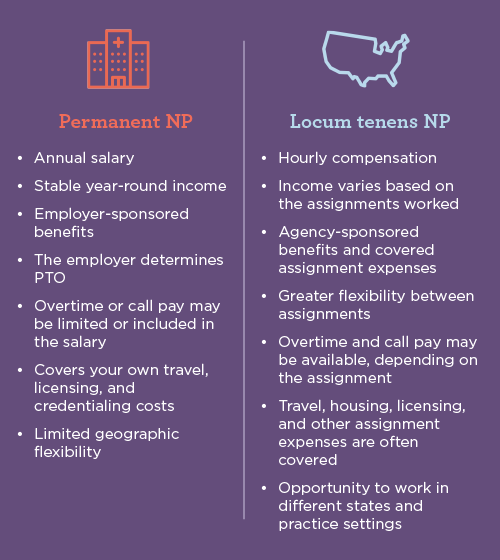
Compensation comparison
Here's how the two compensation models generally compare.
Clinicians transitioning to locums often note the direct financial clarity of the hourly model. As family nurse practitioner Nidhi Singh notes:
To me, it was definitely worth it. I am definitely making way more than I was in the brick-and-mortar setting. I also feel like the compensation has been very fair to what we are doing.
However, traveling nurse practitioner Katherine Allen emphasizes that gross income figures require careful personal management:
"Overall, the pay is significantly more, you’re expected to maintain housing in two locations, you’re buying things at each different location if you’re flying there that you may have to replace at the next, so there are some additional associated costs, but I think overall you still come out in the positive doing locums versus taking a permanent job."
Benefits comparison
A common misconception is that choosing temporary work means forfeiting benefits. While independent 1099 contractors are typically on their own, nurse practitioners working locum tenens through CompHealth are classified as W-2 employees. That means eligible clinicians have access to a comprehensive benefits suite, including health insurance from the get-go, dental and vision care, a matching 401(k) plan, and voluntary coverage options such as pet insurance.
We offer more than just competitive pay: Learn about more CompHealth benefits
Non-cash compensation: What the agency covers
When calculating the total value of a locums contract, it's also worth accounting for the agency's overhead costs.
Depending on the assignment, agencies may coordinate and pay for:

State licensing

Credentialing

Travel

Housing

Transportation

Medical malpractice insurance
Family nurse practitioner Patricia Maybee highlights how this non-cash compensation changes the financial math:
"I worked in Native American Health, so I didn’t make as much as you would in the private sector, but my housing was paid for."
CompHealth has an insurance plan and a 401(k) plan I can sign up for. It's like being employed.
How does locum tenens work for nurse practitioners?
What locum tenens means for NPs: Locum tenens allows nurse practitioners to work temporary clinical assignments instead of holding a single permanent position. Assignments are highly variable and can last anywhere from a few days to several months. Some NPs take occasional assignments between permanent jobs, while others build full-time careers working locum tenens year-round.
Why NPs work locum tenens: The motivations driving nurse practitioners to enter the locum tenens landscape vary widely depending on career stage and personal lifestyle goals. Many NPs choose locum tenens to earn more, pay down student loans faster, enjoy greater schedule flexibility, or experience different practice settings.
Michelle Freiberger, an NP who transitioned to full-time locums to merge her profession with her passion for the outdoors, shares:
When you’re working a regular nine-to-five job, you get like one week off a year, two weeks off a year, and I’ve gotten to the point in my career that that just isn’t enough time.
"I need more time to explore the world. I can let my recruiter know my plans and say, 'Look, I’m planning to take this much time off. I definitely want to come back.'”
“Where else can you do that? Nowhere."
For others, the main appeal is clinical and cultural growth. Katherine Allen reflects on the educational return of traveling:

The other thing I really love about locums is that you learn something new about medicine at each place, so I have learned and grown so much as a clinician by being around so many different providers and practice styles.
How NPs find locum tenens assignments: Most NPs find assignments through a staffing agency like CompHealth. A recruiter helps match clinicians with available opportunities and, once an optimal match is found, handles the logistical heavy lifting, such as credentialing and onboarding.
How NPs are paid: When working an assignment through a standard staffing agency like CompHealth, hours are submitted through a dedicated portal, such as MyCompHealth. Compensation is distributed via weekly direct deposit.
Additional financial considerations for locum tenens NPs

Taxes
Most nurse practitioners working locum tenens through CompHealth are employed as W-2 employees rather than independent contractors. Taxes are withheld through payroll, which simplifies filing compared with managing quarterly estimated tax payments as a 1099 contractor.
Multi-state licensing
Sourcing individual state licenses independently can be historically slow and administratively frustrating. Fortunately, full-service staffing agencies can expand your clinical availability across multiple states and significantly increase your access to higher-paying contracts.

APRN Compact
The Advanced Practice Registered Nurse (APRN) Compact represents an ongoing legislative push designed to allow an eligible NP to hold a single multi-state license. Its passing will dramatically lower the structural barriers facing locum tenens NPs.

Student loan considerations
If you're working toward student loan forgiveness or repayment, certain locum tenens assignments in federally designated shortage areas may help you qualify for additional programs.

Retirement planning
While retirement benefits vary by employer, many W-2 locum tenens agencies offer a 401(k) program. This allows eligible nurse practitioners to save for retirement without giving up the flexibility of locum tenens work.
FAQs
How much do locum tenens nurse practitioners make per hour?
Most active locum tenens nurse practitioners earn between $70 and $135 or more per hour. Exact earnings depend on your clinical specialty, demand, the location of the opportunity, and the hours of the job itself (weekends and evenings typically pay more than a 9-to-5 commitment).
Do locum tenens NPs make more than permanent NPs?
It’s hard to say. While locum contracts consistently showcase significantly higher hourly rates than the equivalent hourly breakdown of a permanent salary, your total annual income depends entirely on how many weeks you choose to work.
Which NP specialty earns the highest locum tenens pay?
Psychiatric mental health nurse practitioners (PMHNPs) and cardiovascular nurse practitioners consistently rank among the highest-paid locum tenens NP specialties. PMHNP assignments often pay $95 to $145+ per hour, while cardiovascular NPs can earn $100 to $135 per hour, depending on the role and location.
Does location affect locum tenens NP salary?
Yes. Some of the best-paying locum tenens assignments are in rural and underserved areas, where healthcare organizations offer higher hourly rates to fill persistent staffing gaps.
Are travel and housing included in locum tenens NP assignments?
Typically, yes. Depending on the assignment, your staffing agency may coordinate and cover travel, furnished housing, transportation, and malpractice insurance.
How are locum tenens nurse practitioners paid?
Clinicians working assignments through a full-service agency are typically paid as W-2 employees rather than as 1099 independent contractors. Hours are tracked and submitted digitally through a centralized portal, and compensation is distributed via weekly direct deposits.
Is locum tenens a good option for NPs seeking higher earnings?
For many nurse practitioners, locum tenens offers the opportunity to earn more while gaining greater flexibility and experience in different practice settings. But whether it's the right fit depends on your professional goals, lifestyle, and willingness to travel.
Ultimately, the right choice depends on your career goals, financial priorities, and the kind of work-life balance you're looking for.
Interested in learning more about our NP opportunities? We can help. Give us a call at 800.453.3030 or view today’s locum tenens job openings.